
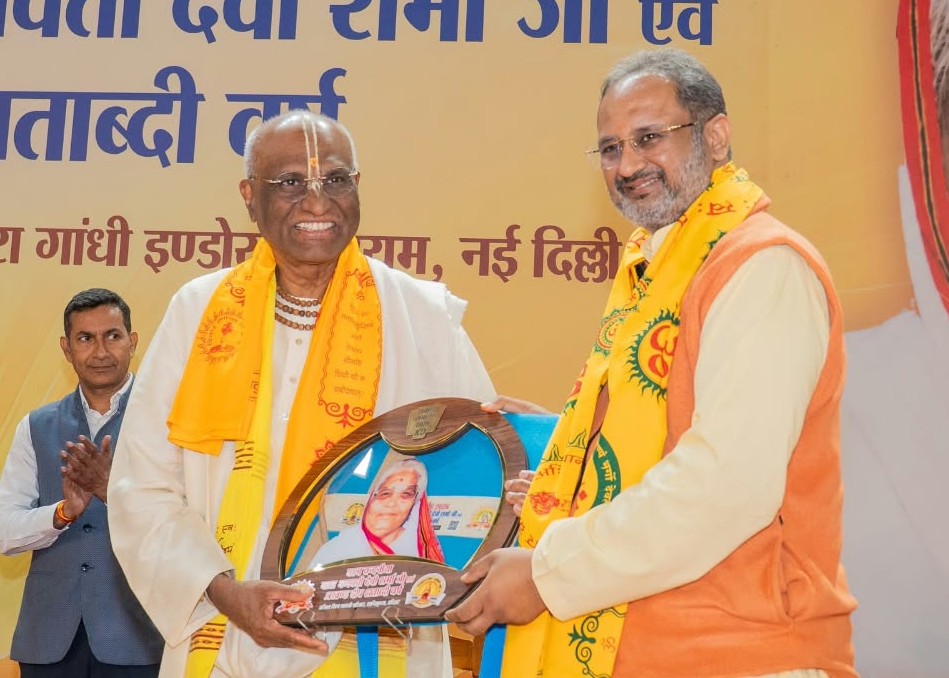
At Gayatri Pariwar Centenary, Sri Madhu Pandit Dasa Calls for Spiritual Renaissance to Build an ‘Addiction-Free India’
Speaking at the All World Gayatri Pariwar’s centenary celebrations in New Delhi, ISKCON Bangalore President and Akshaya Patra Chairman Sri Madhu Pandit Dasa underscored that addiction stems from an internal void of purpose, urging a return to Aahara Shuddhi, Satsang, and selfless Seva to inspire the nation’s youth.
New Delhi: Addressing thousands of devotees and distinguished leaders at the All World Gayatri Pariwar’s (AWGP) ‘Centenary Celebrations 2026’ at the Indira Gandhi Indoor Stadium, Sri Madhu Pandit Dasa, President of ISKCON Bangalore and Chairman of The Akshaya Patra Foundation, delivered a compelling discourse on building an addiction-free society.
The landmark gathering, organised to commemorate the birth centenary of revered Mata Bhagwati Devi Sharma, 100 years of the continuous sacred flame (Akhand Deep), and a century of sadhana by Pandit Shriram Sharma Acharya, was attended by Union Social Justice Minister Dr. Virendra Kumar Khatik, AWGP Dalnayak Dr. Chinmay Pandya, and several prominent dignitaries.
Paying homage to the founders, Sri Madhu Pandit Dasa reflected on the sacred flame ignited on Vasant Panchami in 1926 in Anwalkheda. He observed that Mataji’s lifelong austerity and service kept the lamp burning continuously for a century, blossoming into institutions like Shantikunj, Dev Sanskriti Vishwavidyalaya, and a worldwide network of Gayatri Shaktipeeths. Drawing a parallel with ISKCON—which was established in New York in 1966 by A.C. Bhaktivedanta Swami Prabhupada—he noted that both spiritual movements serve as unbroken lights awakening human consciousness beyond transient material and bodily desires.
Turning to the theme of an ‘Addiction-Free India’, Sri Madhu Pandit Dasa cited the Bhagavad Gita to explain the psychology behind substance and digital dependency. He emphasized that whether youth get caught in drug abuse, alcoholism, or digital compulsions, addiction functions merely as a dopamine-driven painkiller for a deeper emotional ailment: the vacuum of purposelessness. When young people lack a higher spiritual purpose and the capacity for tapasya (austerity and patience), they seek escape routes through temporary highs. While government enforcement and supply bans remain vital, he argued that only spiritual organizations can heal the underlying existential void.
To counter this crisis, he outlined three transformative pillars common to Vedic traditions:
Aahara Shuddhi (Purity of Food): Reforming brain chemistry and consciousness through sanctified vegetarian meals (Yajna Bhojan or Prasadam), an ideal mirrored in Akshaya Patra’s mid-day meals for over 2.4 million children daily.
Satsang (Spiritual Association): Providing a nurturing community through local centres and Shaktipeeths so youth are grounded in positive fellowship and noble ideals.
Seva (Selfless Service): Awakening the soul’s natural inclination to serve beyond personal self-interest, instilling resilience, empathy, and higher fulfillment.
Concluding his address, Sri Madhu Pandit Dasa urged the congregation to undertake three practical resolutions (sankalpas): ensuring family celebrations and weddings remain strictly free from intoxicants, dedicating one hour daily without mobile phones for prayer, reading the Gita, and sankirtan with children, and guiding at least one struggling friend toward positive spiritual association through unconditional love and personal example.